
Mid-ocean ridges dynamics
I investigate how magma supply, grain-size evolution, and brittle–ductile weakening shape faulting, crustal thickness, and tectonic structure at mid-ocean ridges.
Research
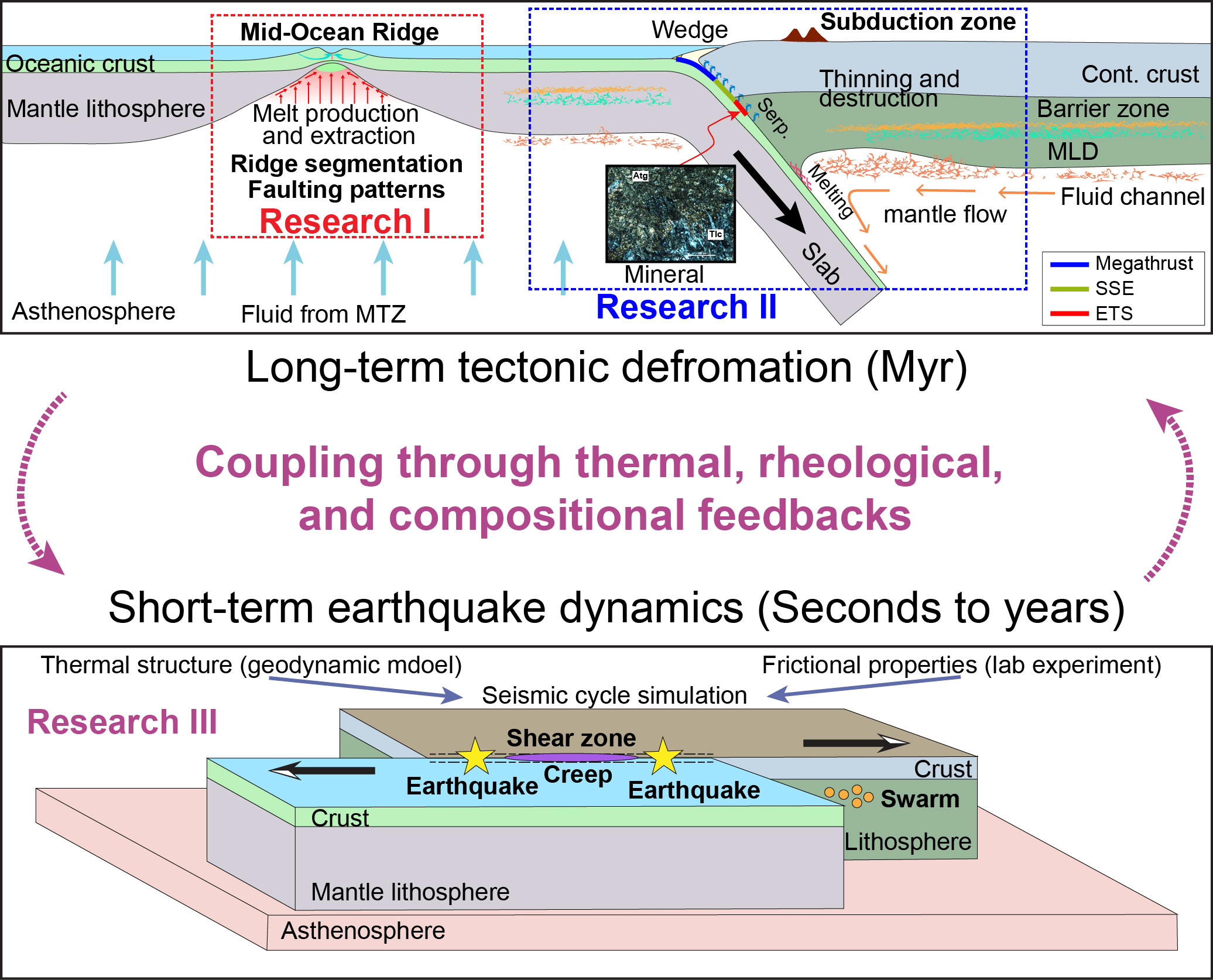
From minerals to mantle, my research deciphers the multi-scale physics that drive the Wilson cycle, bridging grain-scale processes, melt/fluid-rock interactions, and mantle convection to understand Earth's dynamic evolution. My research integrates geological fieldwork, laboratory experiments, and theoretical frameworks to develop next-generation, physics-based 2D/3D numerical models that simulate these complex systems.
My work specifically focuses on two key areas:
Framework
Themes
I investigate how magma supply, grain-size evolution, and brittle–ductile weakening shape faulting, crustal thickness, and tectonic structure at mid-ocean ridges.
I investigate how fluids, melts, and rheological feedbacks reduce lithospheric strength, drive thinning and destruction, and shape the long-term evolution of convergent margins.
I integrate laboratory-derived friction and constitutive laws into seismic cycle models to explain rupture complexity and transform-fault earthquake dynamics.
Methods
Physics-based 2D/3D geodynamic and seismic-cycle simulations designed to connect grain-scale mechanisms with plate-scale behavior.
Experimentally informed constitutive laws for friction, healing, and rheological weakening that can be embedded in dynamic models.
Cross-system analysis spanning oceanic ridges, subduction zones, transform faults, and planetary settings to identify shared physical controls.
Tools
A MATLAB package for THERMO-baric BRIttle-viscous fault dynamics simulations.
An in-development Python package for post-processing and visualizing 2D/3D geodynamic models.